


AMC/Rambler factory radios
Written by Tom Jennings 04-05-2020, edited by Frank Swygert 02-24-2026
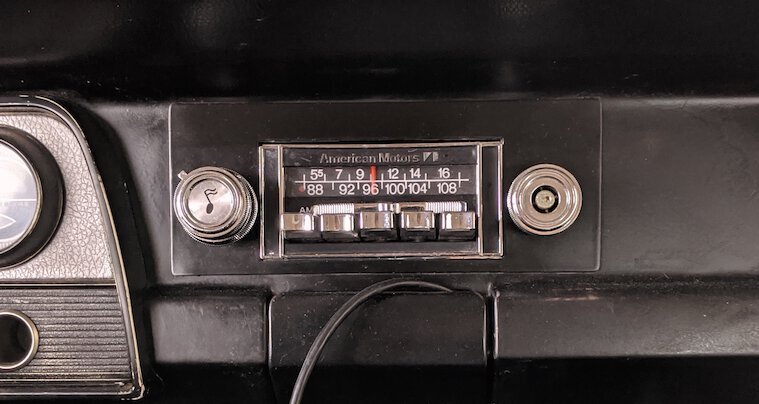
Sometimes six ancient transistors, or four of them plus a few even older electron tubes, are more interesting than the billion transistors in modern electronics. I know that I went through some effort to install a radio in my 1968 Rambler American, filling the ruined hole in the panel with a restored AMC branded AM/FM radio from a Gremlin.
Car radios were options, often expensive, and nearly always lowly AM. By the 1970’s “we” demanded FM and cassette (or the unfortunate 8-track) and I hacked large holes in the panels of cars to install them so that thieves could pry open my vent window and steal them.
Today I have stealth high power stereo with low-passed separate subwoofer and built-in Bluetooth that is literally velcro’d onto the heater box. My phone today has more storage than the NSA had in 1980 plus streaming.
Today the boring old AM radios of the past are a lot more interesting than they had been then and lots of us are sticking back in. If we can find them.
Identifying car radios
Well, you might try this site called Retro Radio Shop. Many Rambler/AMC radios are here, and they also repair and restore old car and home radios, and can convert your classic car radio to modern internals while retaining the classic look. Retro Radio Shop has done such a good job of identifying Rambler/AMC radios that I’m not bothering to repeat their efforts. Instead I’ll concentrate on the “official” Rambler/AMC data instead. There’s more model and visual information here than in the factory documentation!
You will also find some info at Radiomuseum.org. It’s kind of clunky, and you need the model number to find anything specific. You can get a list of car radios by using the Advanced Search and selecting “car radio” as the Category, “USA” as the country, and a radio Manufacturer. AMC typically used Bendix or Motorola radios, but may have used others. The search won’t work without all three categories. If you have the model number it will search by that alone though.
Factory radio information
Below is a compilation of data gleaned from Factory Parts catalogs and Technical Service Manuals (TSM). Radios are a Group 15 (Accessories) part, specifically 15.320 across all years. The data recorded in these official documents is pretty sparse. Radios were clearly an afterthought.
This is in chronological order, with reference(s) to the appropriate parts catalog.
“No data” means that I have no catalog nor TSM for that year.
1957
1957 TSM: No mention of radio found, other than drawing incidentally labeling radio knobs in Instrument Panel section.
1958
No data.
1959
No data.
(Encompassed by Parts Catalog 1960 – 1965)
1960
No data.
1961
1961 American TSM: Motorola Model 13 MAM (manual tuning), Motorola Model 13 MA (push-button tuning), [tomj: ‘hybrid’ transistor and tube], No mention of speaker impedance.
Photo and info at RadioMuseum.org
1961 Classic, Ambassador TSM: Motorola Model 04MA, [tomj: ‘hybrid’ tube and transistor], Some ambiguity here. Spuriously mentions model 14MR (“All speakers used (Radio Model 14MR) are special and not interchangeable…”). Speaker impedance 20 ohms (only). [tomj: 8 ohm or less speakers likely harm the antique output transistor]
1962
1962 American TSM: Bendix Model 22 BAM (manual tuning), Bendix Model 22BA (push-button tuning), [tomj: these are ‘hybrid’ radios — transistors and tubes] 20 ohm speaker (only). [tomj: 8 ohm or less speakers likely harm the antique output transistor]
1962 Classic, Ambassador TSM: Motorola Model 2TMR, “All speakers used (Model 2TMR) are special and not interchangeable with types commonly available [tomj: in 1962].” Ambiguous statement about a front speaker may be installed in rear if “full 8 ohm winding” is used.
1963
1963 Classic, Ambassador TSM: Motorola Model 3TMR, 8 ohm speaker (from Motorola specification).
1963 American TSM: Bendix 3TBAM (manual tuning), Bendix Model 3TBA (push-button tuning).
1964
No data.
1965
1965 American TSM: Bendix Model 5TBAM (manual tuning), Bendix 5TBA (push-button tuning),
Encompassed by Parts Catalog 1966
1966
1966 American TSM: Motorola Model 6SMAM (manual tuning), Motorola Model 6SMA (push-button)
Encompassed by Parts Catalog 1967 – 1972
1967
1967 TSM: Motorola 7SMR push-button AM radio, Motorola AF7MRY push-button AM-FM.
1968
No data.
1969 TSM: American AM Motorola C9SMA, Rebel, Ambassador AM Motorola C9SMR, Rebel, Ambassador AM-FM Motorola F9SMR, Javelin, AMX AM Motorola C9SMG, Javelin, AMX AM-FM Motorola F9SMG, Javelin AMX AM-tape Motorola A9SMG.
1970
Javelin AMX 1970 TSM: No mention of radio models. “Transistorized push-button radios are available on all Series except the 30-70 Series radio-tape player combination which has manual tuning.” All speakers are 8 ohms.
1971
No data.
1972
1972 TSM: “Transistorized push-button radios are available on all Series except the 70 Series radio-tape player combination which has manual tuning.” Speakers are 8 or 3.2 ohms. AM/FM radios require 3.2 ohms, with a warning about not using the wrong impedance.
The 67-72 Parts Catalog does not ever reference “radio” nor is there any illustration other than the antenna. “Radio” is not in the Alphabetic index but “Antenna” is. 15.320-1 is “Attaching parts, radio to instrument panel”. There is no radio mentioned.
To complicate things even further, my copy of the this parts catalog is missing pages T7, T8, T9, T10 covering group 15 parts 15.320-7 through -42, radio parts.
Encompassed by Parts Catalog 1973 – 1978
1973
No data.
1974
No data.
1975
1975 TSM: Manufacturer not listed. All radios are push-button, all speakers are 3.2 ohms. No mention of radio models. AM radio one dash mounted speaker. AM-FM have two or four speakers. AM-FM-Tape is now “entertainment system”. “Radio manufactured date, model, and serial number is stamped on the right side of the radio case (fig. 3-125).”
(’75 Hornet/Gremlin AM-FM radio is Motorola 5HT3510 or variant, from Retro Radio Shop site. Mine has different knobs, and does not have the horizontal slider fader along the top; there is a front/rear fader concentric with the frequency knob.)
1976
1976 TSM: Manufacturer not listed. All radios are push-button, all speakers are 3.2 ohms. No mention of radio models. AM radio one dash mounted speaker. AM-FM have two or four speakers. AM-FM-Tape is now “entertainment system”. “Radio manufactured date, model, and serial number is stamped on the right side of the radio case (fig. 3-125).”
1977
1977 TSM vol 3: Manufacturer not listed. All radios are push-button, all speakers are 3.2 ohms. No mention of radio models. “Radio manufactured date, model, and serial number is stamped on the right side of the radio case.”
1978
No TSM. The parts catalog states, only for year 1978: 01-40, AM, CB, 323-1847 01-40, AM, FM, CB, 323-1848 16-60-80, AM, CB, 323-1849 16-60-80, AM, FM, CB, 323-1850. No part numbers given for 1973 through 1977.
I have no catalogs for 1979.
1979
No data.
1980-88
I have no data for 1980 and up except what was gleaned from my 1980-82 TSMs.
1980 TSM: “All radios are transistorized with push-button tuning and have an output impedance of 3.2 ohms.” “Radio manufactured date, model, and serial number is stamped on the right side of the radio case (fig. 3-125).”
1981 TSM: “All radios are transistorized and have an output impedance of 3.2 ohms.” “Radio manufactured date, model, and serial number is stamped on the right side of the radio case.”
1982 TSM: “All radios are a solid state design and have 3.2 ohms impedance except for the electronically tuned AM/FM/Cassette which has an impedance of 8.0 ohms.” “Radio manufactured date, model, and serial number is stamped on the right side of the radio case.”
1983
No data.
1984
No data.
1985
No data.
1986
No data.
1987
No data.
1988
No data.
Deprecated: File Theme without comments.php is deprecated since version 3.0.0 with no alternative available. Please include a comments.php template in your theme. in /home3/amcmagc1/public_html/wp-includes/functions.php on line 6114
Leave a Reply