
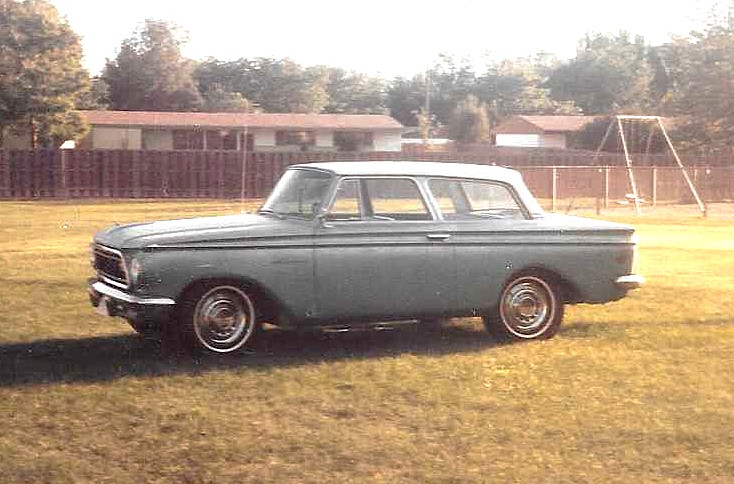
In the fall of 1982 I traded my 63 American (flat-head six, manual three speed with overdrive) and an old 1970 Toyota Corona I was driving in on something more reliable, as I was about to get married. I got a 1976 Chevette two door hatchback with four speed manual that was a relatively low mileage local trade-in. I was without a Rambler! I had my first one, a 1961 American four door wagon (flat-head, manual three speed) in the summer of 1979, and replaced that worn out car with the 63 two door the next year. It was in turn replaced by another 63 220 (same engine/trans) in the spring of 83 due to some structural issues with the front suspension mounting points of the first two door. Those early three cars were pretty much worn out when I got them, especially the front suspension. They all got the flat-head I rebuilt for the first two door, that originally came out of the wagon. The first two door had a blown flat-head (rod through the block blown!), and the second had a locked up flat-head.
Not long after getting married (October 1982) I joined the USAF (April 1983). I drove the Chevette from Batesburg-Leesville, SC (then two separate towns) to Mountain Home Air Force Base (MHAFB) in Idaho, my first big road trip. My wife’s car was left in SC for the time being, to be retrieved on our first visit back home the next year.
Not long after retrieving my wife’s car I started looking for a Rambler. I was having Rambler withdrawals! I sold the Chevette in June 1984, shortly after I found a 63 American 440 sedan in Jerome, ID, not to far from MHAFB, in June of 1984. It had the 195.6 OHV (1 bbl) and automatic transmission. I’d have preferred a manual, but you can’t be too picky when looking for a hard to find car, especially if you’re on a tight budget like a E-3 in the military with a wife and small child!
I ended up keeping this car for 14 years as a daily driver. It literally went from coast to coast! I took it to a AMC/Rambler Club meet in Seattle, WA in 1985 or 86 and drove it to Charleston, SC in the spring of 1987 when I was on leave just before going to assignment in Okinawa, Japan. I left the car at my father’s house near Batesburg-Leesville, SC, for my 26 months in Japan.
While in Japan I fell in love with the wide angle mirrors used on both sides (without the “I’m an idiot and can’t tell cars are closer than they appear” markings) and mounted on the fenders instead of beside the doors. This was common on Japanese cars through the 80s. The wide angle view and forward mounting meant you could see down the side of the car, eliminating blind spots. Technically a wide angle mirror on the driver’s side is illegal in the US (full mirror, not just a small portion blind spot mirror), but I brought a set back with me and used them on my American. I also brought a LeMans style (Dodge Charger style) gas cap from Japan. It may have come from a late 70s or early 80s Nissan Skyline, but I don’t really remember.
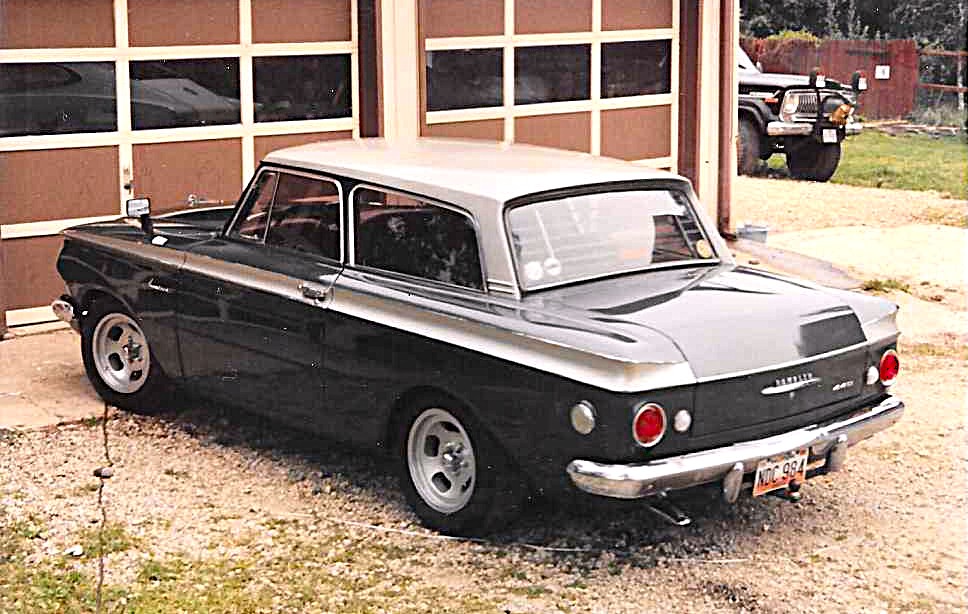
I had it painted in July 1992, just before going to the AMC/Rambler Club meet near Dayton, OH that year. I selected an Eddie Bauer Explorer color, Deep Emerald Green Metallic, with a silver metallic for the side stripe and top. It had been previously painted a dark green with white roof by none other than Earl Schieb in Boise, Idaho, in 1985. The only reason I repainted it in 92 was that the front had got chipped badly driving through a snow storm on the way to SC in 87. Below freezing weather along with sand on the roads made it chip. Otherwise the paint held up very well, surprisingly. Prep is the key to a good paint job, and we know those cheap paint outfits like Earl Scheib (and Maaco today) don’t do a lot of prep work. I did all the prep work before taking it to Earl Scheib. All the chrome was taken off and I wet sanded the entire car. I drove it from MHAFB to Boise then took the tail lights off when I got there. All they had to do was cover the tires and mask the windows. I got a call a few days later saying the car was ready, but there were a few scratches showing through and they’d like to put another coat on. I asked how much, and they said nothing! I made it easy for them, and they wanted it to look it’s best for advertising, they’d just have to keep it a few more days. When it was painted in 92 the Econo-Paint in Warner Robins, GA, did it. I paid them to do some extra prep work, but I de-chromed it first. These guys spray a lot of cars and have the right facility and equipment — they have to be able to do better than I could at home! Prep is the key, and that doesn’t take any special equipment or skills — just time.
I had upgraded the engine to a factory two barrel carburetor before I left Idaho. I had also upgraded the exhaust to a 2″ with 16″ turbo muffler (stock was 1-7/8″head pipe, 1-3/4″ after the big three-pass muffler) and modified the air filter housing to a 4″ snorkel (stock was about 2″). All this helped, bringing it up to about 155 hp (stock 2 bll was 138 hp). The enlarged snorkel made the most noticeable difference — the idle seemed to smooth out. None of it made a real noticeable difference in driving though.
When I rebuilt the engine in 1995 I added an improved camshaft. I called Lunati and asked about a cam re-grind. They asked what I wanted from it, and I replied “just a little more pep”. They told me to send it in! A few weeks later I received the re-ground camshaft. Lunati had added 0.100″ lift (total lift after rocker arm ratio, not on the cam lobe) and 20 degrees duration. Stock is 0.370″ lift and 244 degrees duration, the re-grind was 0.470″ lift and 264 degrees duration. This added about 20 hp to the engine and was immediately noticeable!
There is a catch, however. The 195.6 is a long stroke, small bore (undersquare) engine. There simply isn’t much you can do to make it turn up much quicker — except shortening the stroke. While that can be done by using an older Nash 184 CID 4″ crankshaft and a big overbore (0.125″ – the max!), the resulting 3.25″ bore with the required offset dome on the piston means a special piston (over $1000 in 2025). Not many want to spend that kind of money on these old engines, and it will never be a drag racer anyway. What the bigger cam DOES give is power where it’s most needed — holding highway speeds up hills while cruising and having a little reserve power for passing. From idle to about 1900 rpm there was no noticeable difference in acceleration. Once it hit 1900-2000 rpm (about 45 mph with 195/70R15 tires and 3.31 axle ratio) it had noticeably more power! No more struggling to maintain highway speeds up hills or wondering if you had enough time to pass on two lane roads!
I did a lot with this car. Before improving power, I greatly improved handling. I did this by increasing the front spring rate by 12?% (12% stiffer than stock) and reducing the loaded height by 1/2″. The height probably didn’t make a lot of difference, but the spring rate did. The whole reason for a spring above the upper arm, right above the upper outer trunnion is to reduce roll rate. That’s why AMC didn’t use an anti-roll bar on six cylinder cars until the 1970 suspension re-design (spring was moved inboard on the arms, reducing roll resistance slightly). In this design a stiffer spring will greatly reduce roll, more so than adding an anti-roll bar to the otherwise stock suspension. The factory heavy duty springs are 18-20% stiffer than stock and ride like a stiff old pick-up truck (think 50s-60s truck, not a modern one that rides better than many 60s and 70s cars!). After discussing the use of factory HD springs, I settled on 12% stiffer than stock. This turned out to be the “sweet spot”! Just stiff enough to improve handling with no change in ride comfort on a smooth road. On a rougher road you can tell it’s stiffer, but it’s not uncomfortably stiff like the factory HD springs. I’ve since used a set of springs at 10% stiffer as well. The 10% springs didn’t help handling nearly as much as the 12%, but of course ride wasn’t affected as much either. The difference that 2% made was more than one would expect! I always recommend 12% stiffer than stock — it just seems to be the best compromise.
You can’t improve the front suspension without doing something to the rear as well, not for balanced handling. The rear springs are simple leafs. They can be stiffened by adding leaves, but I used a 500 lb bolt-on “helper” spring that bolts to the rear (long part) of the leaf spring, stiffening it up.
I also upgrade the front brakes in the early 90s. It received front discs from a 1979 Spirit, along with a manual master cylinder. Manual disc brakes take a little more effort than drum brakes, but not much more. Stopping power was greatly improved! The rear brakes were left alone. Most think that if the front braking power is improved the rear should be also, but that’s false! When front braking is improved weight transfer during hard braking is much quicker, which can lead to the rear brakes locking prematurely — something you don’t want! Sometimes it’s necessary to reduce the pressure going to the rear brakes with an adjustable proportioning valve. I didn’t need to — all four wheels would lock at about the same time.
This car ran and handled great! The speed had to be kept in the 40-45 mph range (or rather rpm in the 1900-2000 range) to have good power, but with the improved handling I could easily keep speed up on all but the tightest curves. A friend had a 1976 Pontiac Trans-Am. Even he admitted that my little Rambler handled as good or better than his T/A. Once when we were driving down back roads I didn’t slow much for a 35 mph marked curve. He quickly braced himself against the dash and door. I laughed remarked that he knew the car would handle that curve, why the surprised reaction? I’ll never forget his answer “yeah, but it’s not supposed to!”
I finally sold the car to a fellow in Washington state in the fall of 1999. I had just purchased my 63 Classic wagon (to keep it from becoming someone’s “fishing car”!). I really couldn’t hold on to both cars since I was still active duty USAF and may have to move at any time, but I wasn’t sure which I wanted to keep! So I put both up for sale at the same time. I got an e-mail from a former USAF member who was working for a contractor in South Korea who’s contract was about up. We struck a deal and he flew from Korea into Georgia to pick it up. He then drove it to Washington (I forget what city). We kept in touch for a few years, but lost contact as time progressed. I don’t know what happened to the car, wish I did!