

Camshaft, Timing Chain and Gears
Camshaft, camshaft gear, chain, crankshaft gear, tappets.
Note that the camshaft pictured below is for a 199/232/258 six – 195.6 is similar.
10-30-2025
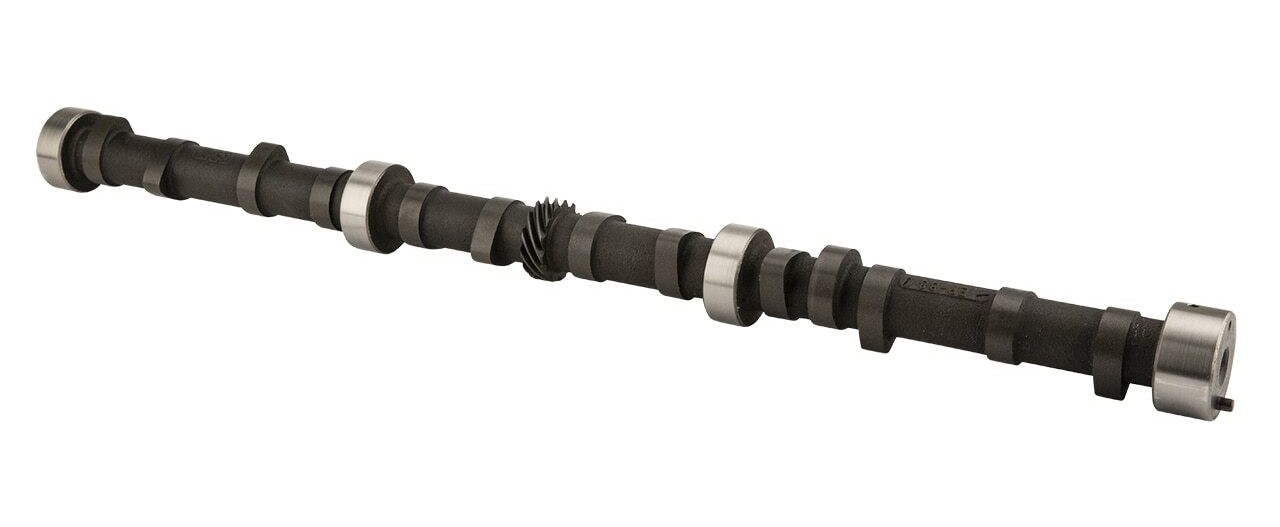
Camshaft
It should be no surprise that there are no aftermarket performance cams for this engine. A used cam must be reground, but because the base circle is only .020″ or so larger than the rough casting increasing lift or duration is limited. You may think that the L-head engine camshaft in the OHV block could be used to generates significantly more lift at the lifter, but the camshafts are too different.
AMC Acres has an “RV” grind that they sell for $210 (plus a refundable $75 core charge if you don’t send in your cam or it’s not usable). This reportedly doesn’t do much, it’s barely noticeable. Frank sent a cam in to Lunati for regrinding around 1994 or 1995. He told Lunati he wanted “a bit more pep” and they added 0.10″ total lift (that’s after the rocker ratio is added) and 20 degrees duration (0.470″ total lift, 264 degrees duration – stock is 0.370″/244 degrees, at least for a 1963 196 OHV). Isky cams has a similar master for the 196 with 0.448″ lift and 264 degrees duration. Any of the cam companies can re-grind a good condition stock cam, by the way.
Frank states that his cam gave the engine about 20 hp in the 2000-4000 rpm range. It did nothing for lower rpm. What it does is give the engine much better cruising power though. This is felt mostly when maintaining highway speeds, especially up hills, and when passing. It really wakes up once it gets up to about 40 mph and has good power all the way up to 75 mph. Frank states that he usually cruised at 65-70 on long trips with no issues or trouble holding speed, something it didn’t do so well with the stock cam. It should be noted that Frank had the 2V WCD carburetor, 2″ exhaust pipe with turbo muffler, and an opened up air breather (the stock 2″ snorkel was replaced with a 4″). A stock 1V engine with factory exhaust should experience a gain, but not quite as much. Frank estimates that his engine made 170-175 hp (gross), about 37 hp over a stock 2V 196’s 138 hp. A stock 1V (125 hp) should develop about 145-150 hp, stock 2V around 158-163 hp with stock exhaust and air cleaner.
The primary problem as far as quickly spinning up is this is a small bore/long stroke engine. There is little that can be done to make it spin up faster, except for shortening the stroke. Frank has an old hot rodding magazine article with a photo and caption about a fellow who won his division with a 1955 Nash Rambler and built OHV six. It was a 196 block bored 0.125″ over with a shorter stroke 184 Nash L-head crankshaft (4″ vs 4.25″). With the bored block the engine displaced 199 cubic inches. The times and speeds weren’t mentioned.
The BLOCK section contains camshaft bearing information.
Timing Chain and Gears
The aftermarket calls the combination of the two gears and chain the “timing set”. You could once buy kits for this engine, but no longer (some of the AMC vendors sell a “set”). Be extremely wary of bad information, measure if in doubt. The aluminum engine parts and L-head parts ” looks like” the OHV’s but are not usable, and are easily found on eBay because no one wants them.
The following is always true for the timing parts for the 195.6, 184 and 172.6 engines back to 1946. Count the links of the chain. I believe the list of applications is: 1946-1948 Nash 600, 1950-1956 Nash Rambler, 1958-1965 Rambler American.
| Specifications for all cast iron 195.6 engines | |
|---|---|
| Camshaft sprocket | 46 teeth |
| Crankshaft sprocket | 23 teeth |
| Timing chain | 60 teeth |
All OHV engine timing chains are 1″ wide, and the teeth of OHV gears are 3/4″ wide. There exist 3/4″ wide chains and 5/8″ wide gears. These do not fit the OHV engine. I presume they fit some L-head engines.
These are the correct part numbers for the 195.6 OHV engine timing components (3/4″ gears, 1″ chain). As of this writing Egge Pistons has these parts available. They are the correct part for the engine. I’ve installed them and verified the numbers, which are stamped on each gear. AMC vendors should also have the correct parts.
| Cam sprocket | 317 5869, #229 |
| Crank sprocket | 317 5870, #230 |
| Chain | 312 5871, #339 |
1-inch crankshaft gear closeup.

Approximate gear width, for 1-inch chain.

1946 (Nash) to … 3/4″ L-head chain timing set
I think — not verified — that the 3/4″ parts are for L-head engines. They do not fit the OHV engine. I bought a Melling #365 and it is 3/4″ wide. Late model L-head engines may use the same set as the OHV, but I’m not positive.
| Cam gear | 312 2388 | |
| Crank gear | 312 2389 | |
| Chain | 312 2392, Melling 365 |
Here is the RockAuto Melling 365 info page.
Tappets (lifters)


Do not use resurfaced tappets!
For my 2010 build Tom bought used but resurfaced tappets. This turned out to be a mistake, as the resurfacing removed all of the hardened surface of the mushroom head, precisely where it is most critical. The working face of all 12 tappets was severely pitted. The cam lobes were fine, no scoring. This was not an oiling issue, but metallurgy. Don’t use resurfaced tappets.
According to Frank it’s possible that the surfaces could be case hardened by a welding shop. This actually isn’t hard to do yourself with something like Cherry Red Hardening Compound. Simply heat the surface to be hardened to a cherry red with a propane torch. cover with the compound, re-heat to cherry red, then quench in water or oil. You don’t have to quench — it can be allowed to cool naturally then any excess brushed or washed off with water. The vendors who sell re-surfaced tappets should really be doing this.
For Tom’s 2017 build new NOS tappets were purchased from Kanter. They have a faint crown. The mushroom head is black oxide, as is the pushrod ball socket. Overall length of the NOS tappets is 1.878″, the old ones ere shorter at 1.864″ in height. This implies that the resurfaced parts had .014″ removed, assuming all tappets were initially the same height.
Mushroom tappets are an improvement over conventional flat tappets but are generally not as efficient as roller lifters (which have replaced them). The larger contact surface increases the lifter velocity, leading to reduced wear and decreased unit loading. A mushroom tappet will produce better power over a broader range than could be achieved with a standard conventional diameter tappet due to the large diameter of the head. Reducing the unit loading helps ensure lobe surviveability, even with more radical lobe profiles. Since the lifter stem diameter is reduced, a savings in valvetrain weight is achieved, allowing a reduction of valve spring pressure and hence wear in the valvetrain. As the diameter of the fiat tappet base increases, so does the engine’s effective breathing area. There are some wear issues described below, but they are minimal on a low stressed engine like the 195.6. The biggest disadvantage is they can’t be removed from the engine without removing the camshaft, and they are mechanical and require periodic adjustment.
There’s a discernible (thumbnail) wear pattern on the cylindrical section, up under the mushroom. This appears to be the lateral force caused by the cam thrusting the follower sideways (rocking) during normal operation; that’s a “feature” of the mushroom design (and why AMC and everyone else ditched them). As the cam operates, the lobe wipes the tappet crown, slightly off-center, rotating the tappet presumably to distribute wear. The follower “rocks” in it’s bore with each cam cycle a tiny amount. This scuffs the cylindrical portion of the tappet top and bottom, the rocking pivot point more or less in the center, but offset towards the pushrod end. It’s just the sum of the leverages. This leaves (microinches) of gap, where there’s no contact the metal is darker (in the pic above). None of this is unusual, it’s just what happens to metal in use, but after 60 years it’s a lot of wear.
Website contents, unless otherwise specified, © 2025 by Tom Jennings and Frank Swygert. Permission is granted for personal use with no renumeration. Corporations or any legal organization or their agents (employees or consultants or other relationships) expressly prohibited without written permission.