
written by Frank Swygert – 03-16-2026
Introduction
AMC used five different front disc brake systems. The first was the 1966-70 Bendix four piston, then 1971-74 Kelsey-Hayes, 75-78 Bendix 3.1″ piston caliper (“Big Bendix”), 77-81 Bendix 2.6″ piston caliper (“Small Bendix”), and finally 82-83 AC Delco.
65-70 Bendix Four Piston
These were the first popular disc brakes available in the US. All US car manufacturers used them starting in 1965. They eventually leaked, causing many to abandon them and convert to later, less troublesome designs.
The issue was the placement of the seal. On these early calipers the seal is on the piston, sliding in the cast iron body. Cast iron is hard, but not as hard and durable as steel. The result was that over years of use the iron bore of the body would wear slightly, eventually leading to leaks. Brake fluid (except silicone based DOT 5) is hygroscopic — meaning it absorbs water from the atmosphere. Brake fluid should be changed periodically, every 2-3 years or 20,000-50,000 miles, but few actually do that, especially on seldom driven vehicles. Water absorption can lead to rust and pitting of the caliper bores, which often occurs in collector vehicles that don’t get driven much. This also leads to leaks, and may be more of a problem than wear.
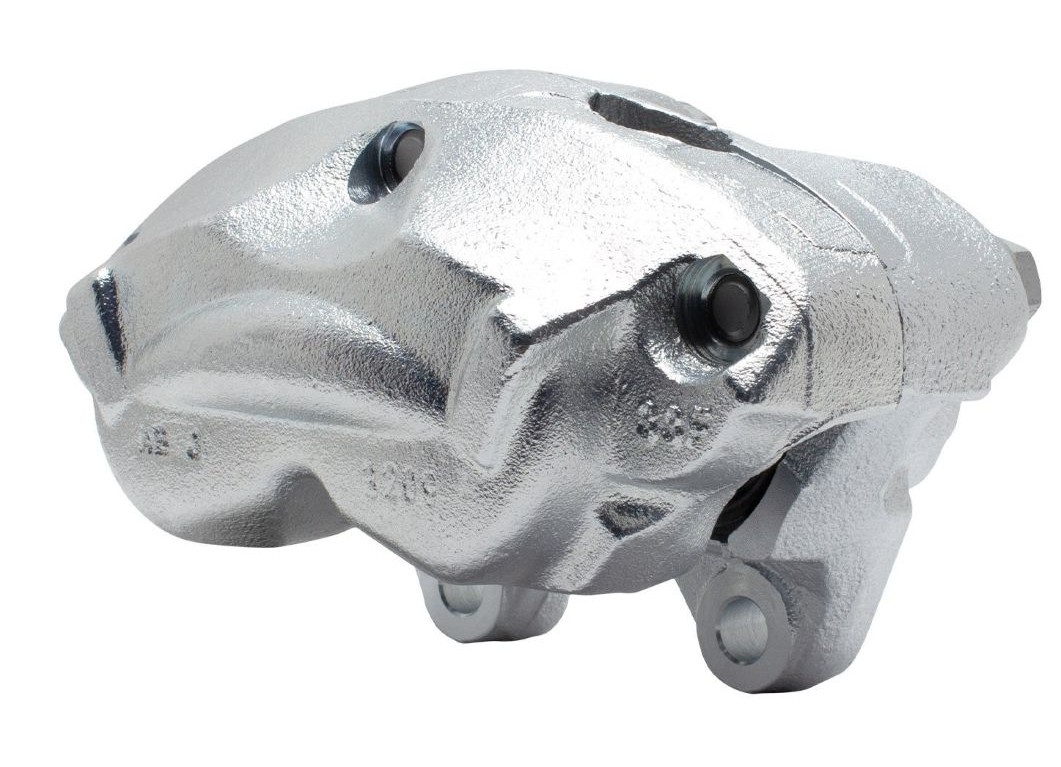
Bendix four piston caliper
In the 1980s-90s it was common to have the calipers bored and sleeved with stainless steel when they started leaking — and they would! Rebuild kits provided new seals which sometimes helped for a short time, but usually not for long. The solution was to send the calipers to a machine shop that specialized in boring and sleeving them with a much more durable stainless steel liner. Stainless steel sleeves address both the wear (harder than cast iron) and rust issues. This service is still available, but can be costly – around $250 per caliper today.
By the mid 80s it was hard to find a replacement caliper for the obsolete design, and as noted sleeving can be expensive (it was back then too!). The calipers will supposedly interchange between all manufacturers. I have seen them listed as “Bendix”, “Budd”, and “Kelsey-Hayes” calipers, but they all apparently interchange. The Bendix as used by AMC and Chrysler has a solid body with an internal passage from one side to the other. Ford Kelsey-Hayes types have an external line that crosses from one side to the other. I have been told that the Ford type should interchange with Bendix, but haven’t verified this. This interchangeability is good news, as there are now AMC/Chrysler replacement calipers being made. The hose mounting point is slightly different on AMC and Chrysler types. This is easily fixed by bending the metal line on the AMC, but it’s a tight bend. Better to get banjo bolt hoses and banjo bolt to fit. Actual AMC calipers are hard to find and probably need work like lining with stainless steel, unless it’s already been done. The Chrysler style new reproductions are currently (2026) in the $125-$150 range depending on retailer.
Another issue with these brakes is that the rotor is a solid piece of steel, 1/2″ thick at the rotor. They are a hat type that fit on the same hub as used by drum brake cars. These are relatively simple rotors and are readily available from several sources in the $60-150 range (2026) depending on retailer. For normal driving they are fine, even some “spirited” driving. Under hard, prolonged on/off braking, such as road racing, they can heat up and start to show fade like drum brakes, but it does take them a lot longer to fade than drums. If you have these there is no longer any reason to “upgrade” to a later model vented type unless you are road racing the car, then you might want to.
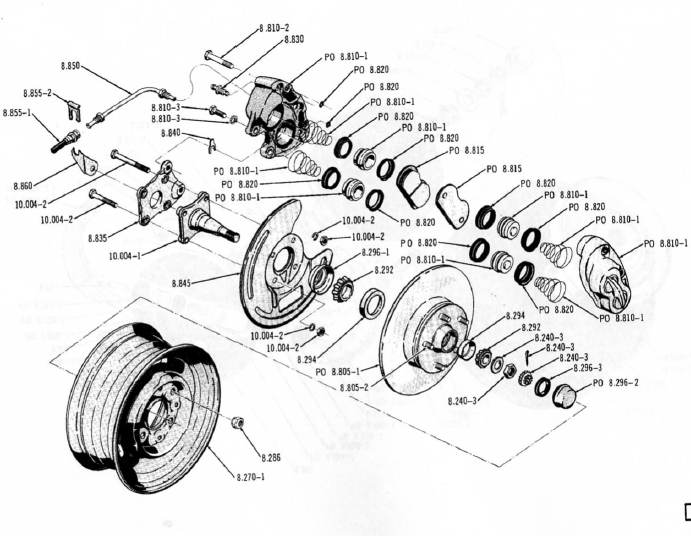
Bendix four piston setup from 67-72 AMC Parts Book
1971-74 Kelsey-Hayes
In 1971 AMC switched to the simpler and less expensive Kelsey-Hayes single piston caliper. This used the now common single large piston in the back with a frame that slides on the mounting bracket. The frame is held to the bracket by two pins. By now the problem with mounting the seal on the piston (bore wear) was well known and all disc brake manufacturers had made the simple change of moving the seal to the body to prevent leaks. Even if the body rusts and pits it still won’t cause leaks. If the piston should wear it’s a small easily made pressed steel part that’s very easy to replace. Since it’s steel it doesn’t wear much, but could rust. No problem, pop it out and replace it!
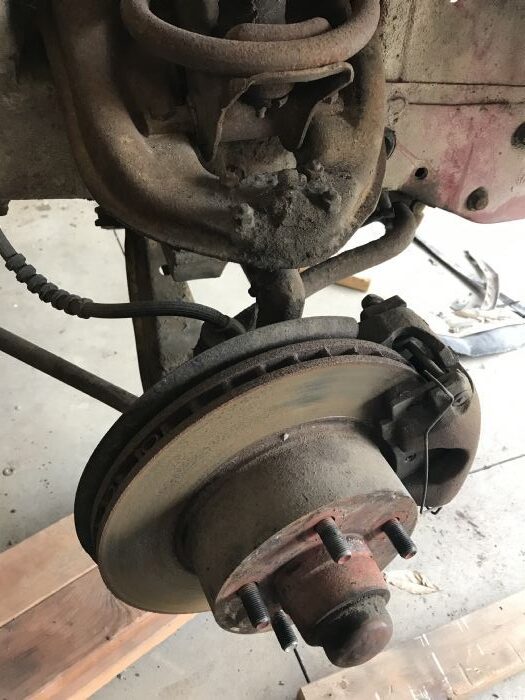
Kelsey Hayes installed on a 71 Javelin
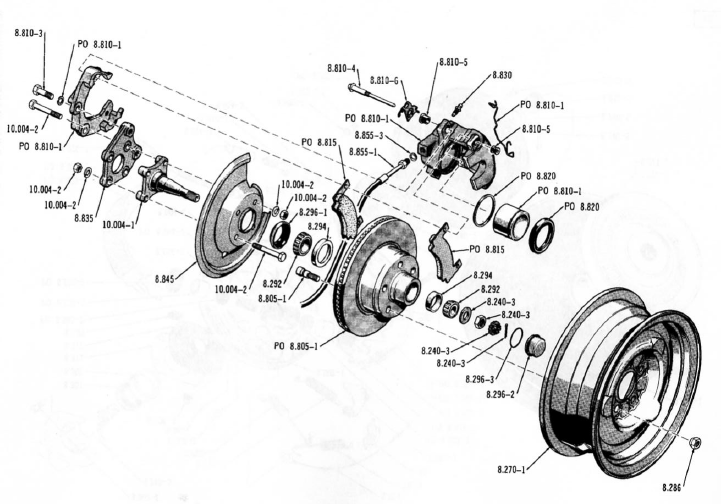
Kelsey-Hayes setup from 67-72 AMC Parts Book
1975-78 “Big Bendix”
In 1975 AMC switched to Bendix single piston brakes. These use a caliper that slides on the frame, using a stiff leaf spring and wedge system to hold the caliper on the bracket. When a car sits for a long time these can stick. I have them on my 63 Classic (23 years!) from a 1979 Spirit and have never had a sticking issue. I assemble them with anti-seize compound on the slide and leaf contact areas instead of grease, so that probably helps. My car sometimes sits for three months, though more often it’s only 6-8 weeks. They may stick a little the first brake application or two, but that’s all. There is no documented reason that AMC switched to Bendix, but it was most likely cost. Chrysler was using Kelsey-Hayes at about the same time AMC was, but Ford used Bendix brakes and had way higher sales than Chrysler. Ford’s volume probably brought AMC’s cost down a bit. We don’t think much about spending an extra few cents on something, but when multiplied by 100,000 or more vehicles using them (AMC went to all front discs about this time) a few cents saved per vehicle adds up! This type of brake caliper does drag a little more than the freer floating pin type (Kelsey-Hayes and AC Delco).
These are typically called “Big Bendix” due to the 3.1″ diameter caliper piston. They were used on 75-78 Matadors and all 75-76 models. The rotor is unique to all 75-78 models due to using a larger wheel bearing set (and matching spindle – A16 outer, A17 inner) than all other AMC front wheels, which used the same set for drum and disc brakes (A2 outer, A6 inner). This rotor is also thicker than Kelsey-Hayes or “Small Bendix” rotors — 1.190″ vs 0.880″. Many road racers in the 80s and 90s used the “Big Bendix” brakes mainly for the better cooling of the thicker rotor. What can be confusing is that the 77-78 Concord, Spirit, and Pacer used the large bearing spindle and rotor but a smaller 2.6″ piston caliper.
The big bearing rotors are now almost impossible to find, often running $200-250 each when you do. Most of the AMC specific vendors still have some, but not all. Some stores and on-line vendors mistakenly list the rotors for 71-74 or 79-83 as fitting, but they do not fit! Big Bendix brakes are often replaced with aftermarket (such as the brackets for Honda rotors and calipers that I sell) or 79-83 AMC disc brakes due to the high rotor cost. The calipers are still available at a reasonable cost though, re-manufactured are around $25, new around $90.
Another “fly in the ointment” is that the 2.0L four cylinder cars used the same calipers but a smaller diameter and thinner rotor! These rotors are 10.28″ in diameter and 0.87″ thick versus six cylinder and V-8 car rotors that are 10.83″ in diameter and 1.190″ thick. To make up for the thinner rotor the brake pads have thicker steel bases. 77-78 Gremlin/78 Concord 2.0L rotors still use the big bearings and won’t fit other cars.
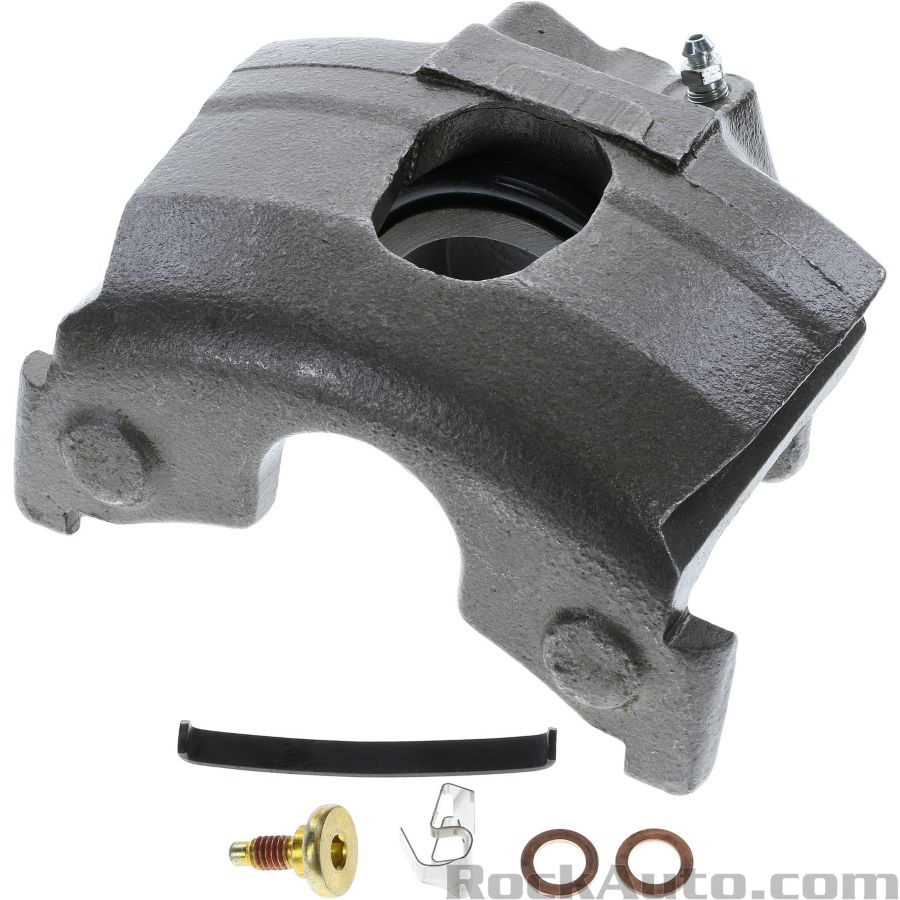
Bendix caliper. The spring rides in the top of the rotor on a drive in slide that the screw retains. The spring and slide ride in the notch seen on the right side in the photo. There is a matching notch on the other side that the lower portion of the frame rides in.
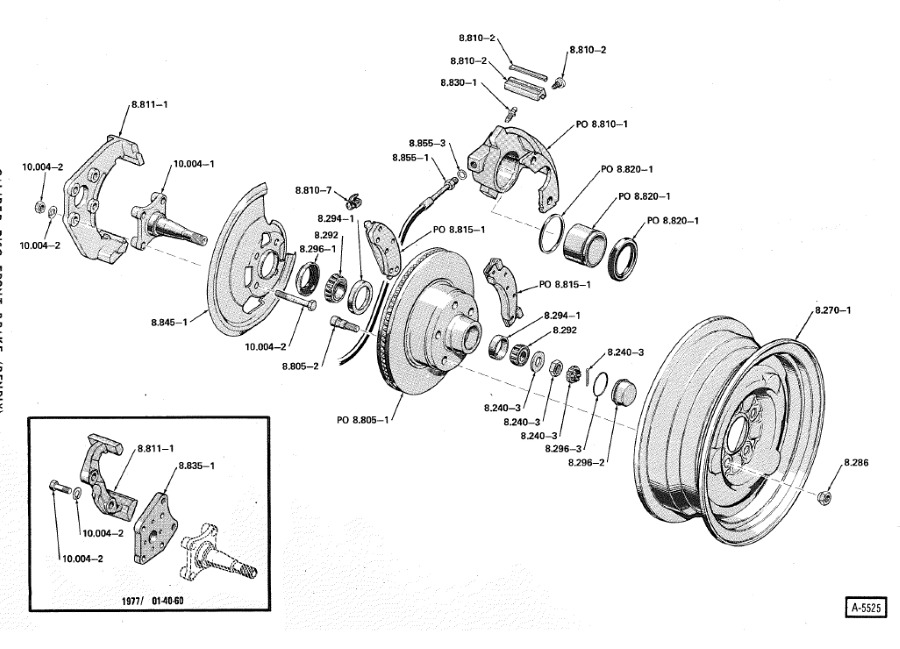
Bendix setup from AMC 73-78 Parts Book. Matador used the bracket without spacer/adapter, small cars used the spacer/adapter plate (8.835-1).
1979-81 “Small Bendix”
AMC changed to a smaller 2.6″ piston caliper in 1979 and back to the smaller bearing spindle used before 1975. Well, they actually changed to the 2.6″ Bendix caliper in 1977 for the small cars, but 77-78 retained the large bearing rotors. This can make buying rotors confusing, and some parts stores mistakenly list 79-81 rotors as fitting 77-78 small cars.
The 79-83 cars all used the same rotor, even the AC-Delco caliper models. The exception is that the 2.0L and 79-80 2.5L four cylinder cars used a smaller diameter 10.28″ rotor like the 77-78 four cylinder models. 1982 four cylinder models used the same 10.83″ diameter rotor as six cylinder cars. All these rotors are the same 0.880″ thickness though.
Since these are the exact same design as the “Big Bendix”, just a different caliper piston diameter and rotor thickness (and diameter for four cylinder models) refer to the above illustrations.
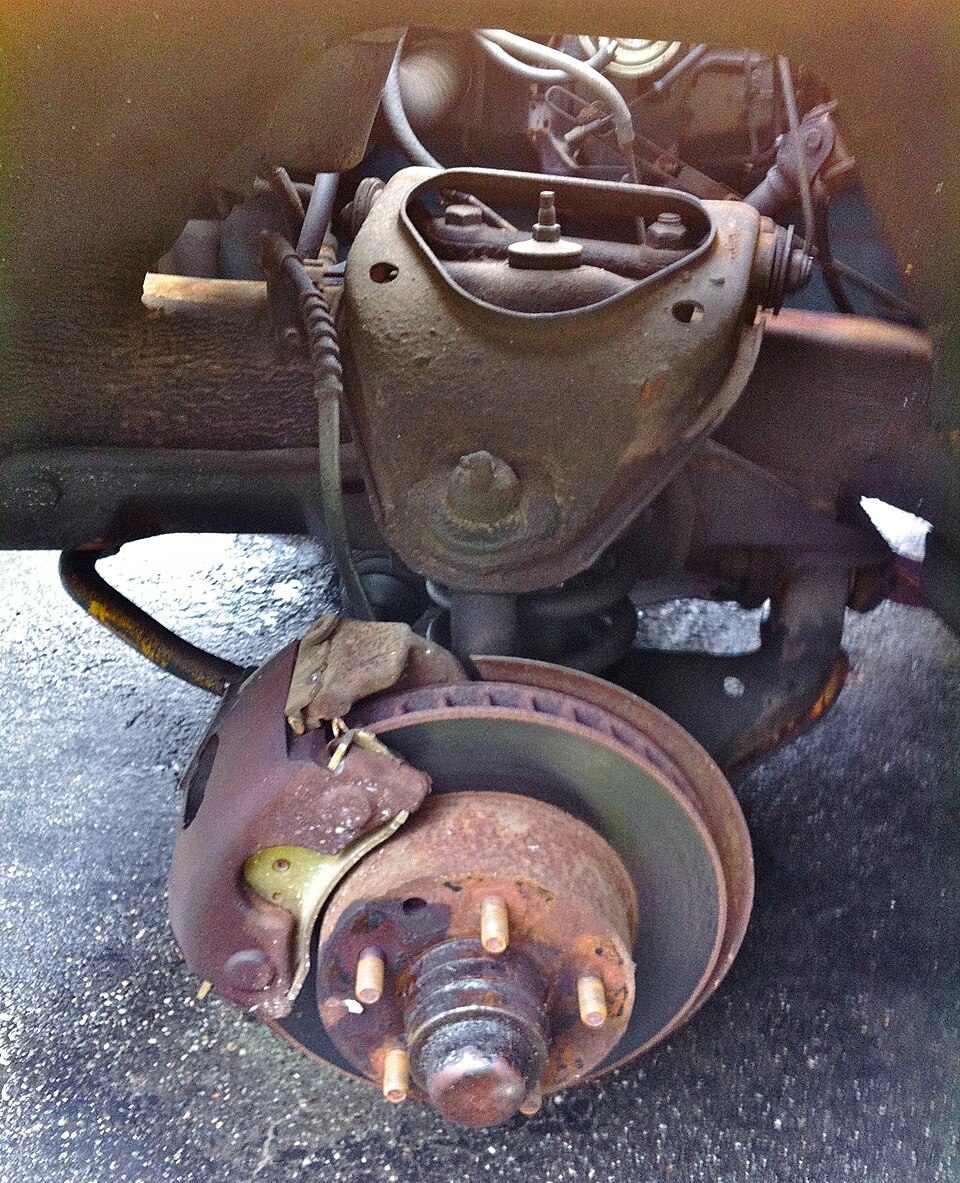
“Small Bendix” brakes on a 1980 Pacer
1982-83 AC-Delco
For the last two years of two wheel drive cars AMC again switched vendors. This time it was mainly due to fuel economy reasons. The AC-Delco calipers are low drag and help gas mileage slightly. I don’t think anyone would really notice, but at that time every little bit helped. A quarter mile to a gallon from low drag brakes, another quarter from aerodynamic changes, etc., all added up as far as marketing was concerned. Looked good when comparing, but AMCs weren’t exactly getting the best gas mileage at that time.
These calipers use a 2.6″ piston like the “Small Bendix”. The main difference is in how they mount. Instead of sliding on the mounting bracket they are pin mount similar to the Kelsey-Hayes calipers. This lets the caliper “float” on the rotor much easier, leading to slightly less drag.
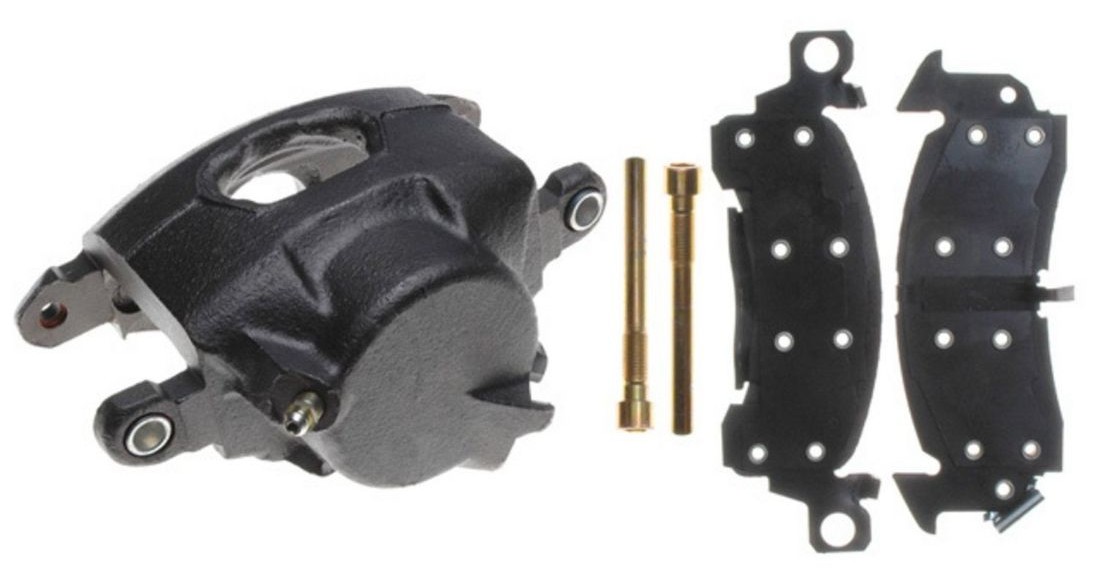
AC-Delco Caliper
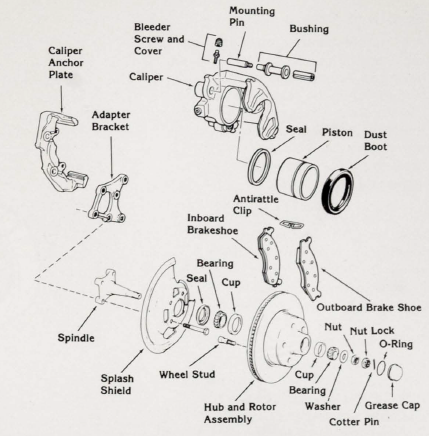
AC-Delco caliper from 83 Product Info book. Note that the “Caliper Anchor Plate” is only used with Bendix brakes. The editors obviously used a parts book illustration that covered brakes prior to 1982 as well as the 82-83 models.