
written by Frank Swygert, 04-29-2026
63-66 CV Joint Woes and Repair
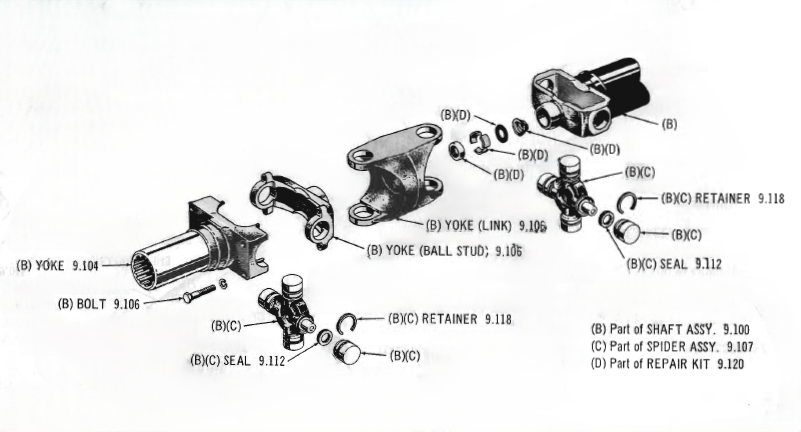
Most torque tube drives use a single universal joint since the only flex point is at the transmission, but 63-66 V-8 models use a double Cardan constant velocity (CV) joint. This was done to reduce vibration and make power transition between the transmission and rear axle smoother. The CV joint consists of two standard universal joints back to back. The center section (yoke link) has a hole in the very center between the joints. The driveshaft end has a seat for a ball stud that extends through the center link to mate with a ball stud on the forward yoke. You can see the seat but not the stud in the parts book illustration above. This ball-stud-and-seat keeps the CV joint centered and prevents it from “flopping around” inside the tube. Unfortunately the seat eventually wears. This lets the driveshaft move inside the tube and creates a lot of vibration. If it is worn too much and driven a lot with the vibration the ball stud can wear or even break off.
Note the parts marked “D” in the illustration are in a repair kit. Unfortunately that kit has been long out of production and unavailable even from AMC vendors. There have been rumors of someone getting it reproduced, but it hasn’t happened yet. I’m not sure an original kit even exists anymore! They weren’t often needed due to the protected nature of the torque-tube. U-joints last a VERY long time not exposed to the elements! The ball stud was made onto “YOKE (BALL STUD) 9.106”. The ball stud isn’t replaceable – if it’s broke off that yoke has to be replaced. Luckily it usually only breaks when the seat is worn out, well after vibration has alerted you that something is wrong.
The fix is to have the tubular front part of the driveshaft that the CV joint is attached to lengthened and use a single joint like the 56-62 V-8 models did. There is no noticeable difference between the CV joint and a single joint. Alternately you discard the torque tube and rear axle and build a rear suspension.
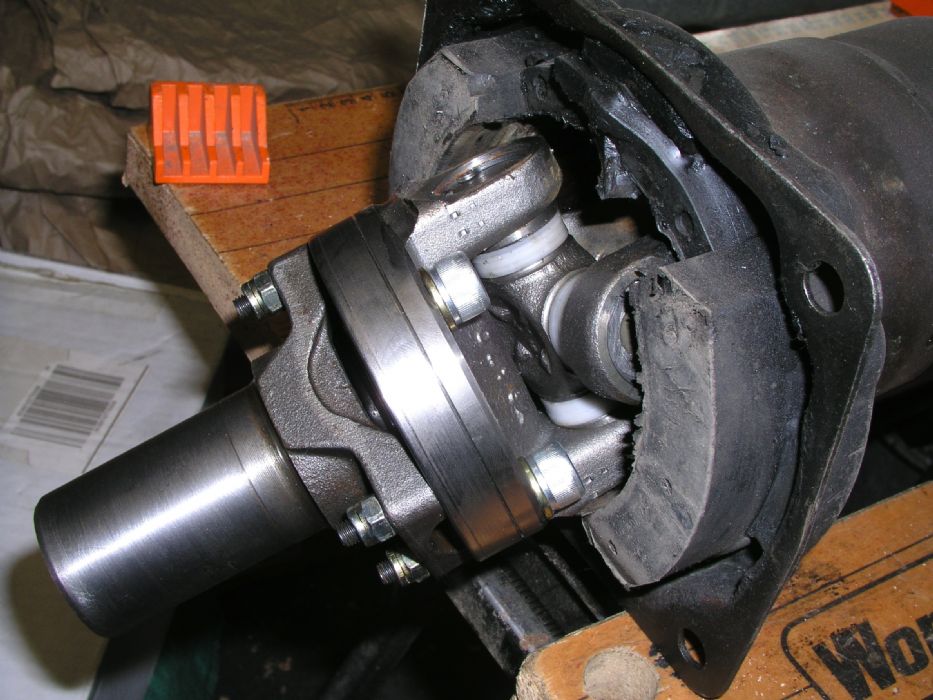
CV joint replaced with a single joint. The driveshaft shop shortened the tubular front half of the driveshaft and welded the end of another driveshaft to it. They used a joint with a flange (possibly a late model Ford joint and flange for 7.5″ or 8.8″ axle — Ranger or Explorer) and made an intermediate adapter plate to bolt the original transmission yoke to it. The U-joint is now where the center of the CV joint was.