

by Frank Swygert – last updated 03-08-2026
The 64-68 Mustang 16 gallon gas tank has become a “universal” tank for many hot rodders. It’s easily adaptable to many Rambler and AMC models when there is no replacement available. The best thing is the stock Ford Mustang sending unit is compatible with AMC gauges from the 50s all the way up to 1976. Some have been using the 62-67 Chevy II 16 gallon tank also. The filler on it comes out the left side (driver’s side of US car), making it easier for some installations. I will discuss the Mustang tank first, then the Chevy II.
Read through the Mustang section even if you are considering the Chevy II as there is some information that will be useful.
Mustang Gas Tank
The first thing to consider is the size of the tank. From the outside edges of the flange the Mustang tank is 32-3/4″ (some sources list 32-5/8”) wide x 24-1/2″ front to back (of car) x 7-1/2″ deep (some sources list 8”). It has a “kick up” in the rear, roughly the last 6″ kicked up to a depth of about 5″. The size of the tank less the perimeter flange is 30-1/4” wide x 21-3/4” front to back. This tank has a 16 gallon capacity, enough for most. There is a higher capacity 22 gallon version that is 9-3/4” deep with a kick-up the same as the 16 gallon.
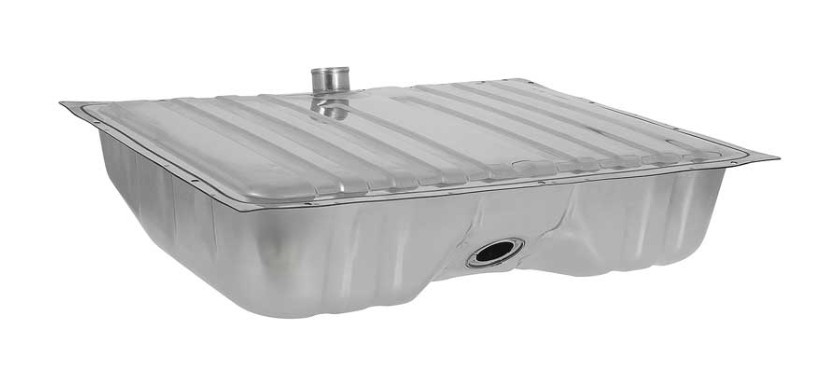
Measure your original tank. If it is no larger than the Mustang tank you can use it. It doesn’t matter if the Mustang tank is smaller. The flanges around the perimeter can actually be bent up or down to gain some more room if necessary, about 1-1/4” on each side. I wouldn’t cut them off – you could cause a leak.
There are several ways to mount the tank. Mustangs use the tank as the trunk floor. Some simply cut a 30-1/4” x 21-3/4” hole in the trunk of their Rambler and drop the tank in. It is secured around the flange with screws. I don’t recommend this – not unless your trunk floor needs replacing anyway. Note that the 16 gallon tank leaves a relatively flat floor, the 22 gallon model extends up into the trunk about 1-3/4”.
It’s just as easy to suspend the tank under the floor with the original tank straps. The flanges may need to be bent for the straps to go around it, and the straps may need to be altered in length.
Another way to mount the tank is to use the original mounting flange, but bolt it to the floor with the tank under the car with just the bolt heads inside. To do this first drill four bolt holes in the trunk matching the location of the holes in the tank flange near the corners. Put these four in the holes in the trunk from the top and put nuts and lock washers on them under the floor. These will be used to hold the tank up while the others are put in. You might want to do all of them that way. If you’re concerned about pulling too much on the flange install a second nut to act as a stop. I suggest using carriage bolts or round Phillips head machine screws. You don’t necessarily need all of them. I would only use one in each corner then at least two along the short sides (four along sides including corners) and six along the long side (four plus the corners).
So what about the filler neck location? It will work for a few models, like the 64-69 American, but not for most.
The simple solution is to mount a gas cap filler right on the neck. Two problems – if the gas caps doesn’t seal well fumes can get in the passenger compartment, and you have to open the trunk every time you get fuel. Spills can occur when filling, and you have to be careful how you pack the trunk so you don’t block the cap. If you cut the floor out this is easy, otherwise just cut a hole for the filler neck to come up through the floor. This is far from ideal, but workable in a pinch.
By far the best solution is to remove the filler neck from the tank and weld a cap over it. If you don’t weld or have a friend who can weld sheet metal, a welding shop won’t charge much. You will also need to weld on a new filler neck in the appropriate location. You can find different pre-bent lengths of exhaust tubing at most parts stores in various diameters. Most will use a 1-1/2” or 2” filler. If a low fuel filler is used (such as the stock 63-66 Classic/Marlin/Ambassador location) a 1/2″ or larger vent tube will be needed near the top to allow air to escape when filling the tank. That’s what the stock Classic/Marlin/Ambassador fuel tank uses – the vent tube runs up to the gas cap.
You can screw a plate over the original hole, but you must use a gasket (rubberized cork preferred) and a screw every ½” around to make sure it seals. In this case the plate should be about 1/16” thick (14-16 gauge) so it will be stiff enough for a good seal. Use ½” self tapping screws. Be careful not to strip the holes as you’re just going into thin sheet metal. Pre-drill the holes in the plate slightly larger than the screws so you’re just self-tapping into the tank metal. It is possible to bolt a short neck on with a gasket also. Tanks Inc. has a good selection of bolt-on filler necks with gaskets and backer rings. You can get to the back of a filler to put a nut on, you can’t for a cap. Note that bolting on works, but does leave a place for possible leaks in the future.
Chevy II Gas Tank
The 62-67 Chevy II/Nova tank is also a popular tank to use. It is 34-1/4″ x 18-7/8″ x 8-3/4″ deep near the front, tapering to about 5-1/2″ deep at the rear. It is also a 16 gallon tank. The fuel filler is on the left (driver’s) side near the top front. This is a good fit in the 63-66 Classic/Marlin/Ambassador. The filler can easily be capped and moved to the bottom of the tank (there is a convenient flat area for this). Loren McAfee modified the rear sill instead, allowing the original Chevy II filler to pass through the rear sill of the Rambler rather than under it. If a low fuel filler is used (such as the stock 63-66 Classic/Marlin/Ambassador location) a 1/2″ or larger vent tube will be needed near the top to allow air to escape when filling the tank. That’s what the stock Classic/Marlin/Ambassador fuel tank uses – the vent tube runs up to the gas cap.
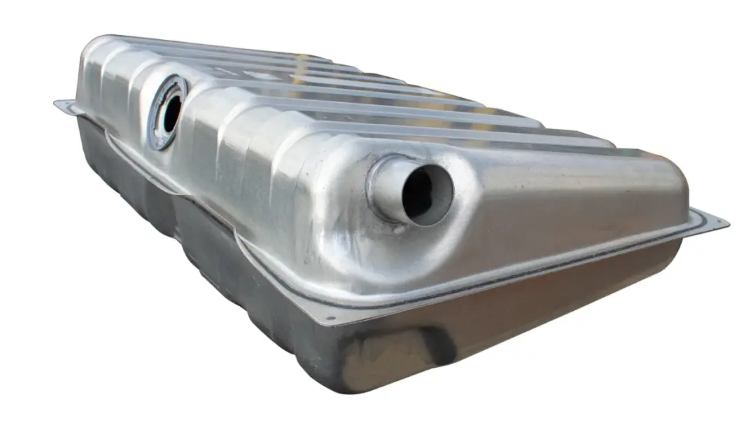
The biggest issue with using a Chevy tank of any kind is the fuel gauge sending unit. Chevy sending units read 0 ohms empty. 62-65 read 30 ohms full, 66-67 90 ohms full. You will need a different sending unit or a gauge to match the Chevy unit.
Universal sending units with the AMC/Ford/Chrysler ohm range of 73 ohms empty/9-10 ohms full can be used. You may be able to find a Ford unit that doesn’t need much modification to work. The fuel tank mounting hole is usually close enough to the same size on Ford and Chevy sending units to to work and seal.
You can also take the actual arm/movement off a universal sending unit of the correct ohm range and wire or screw it to the Chevy pickup. Bend float arm to read as near correct as possible. I did this on a fabricated tank for my 63 Classic. I couldn’t bend it to work precisely, it will only read about 3/4 of the gauge sweep. So I adjusted so that empty is correct, and it only reads up to 3/4 full. I don’t need to know if I’m full, I can tell that at the pump, but I do want to know when it’s time to fill back up!
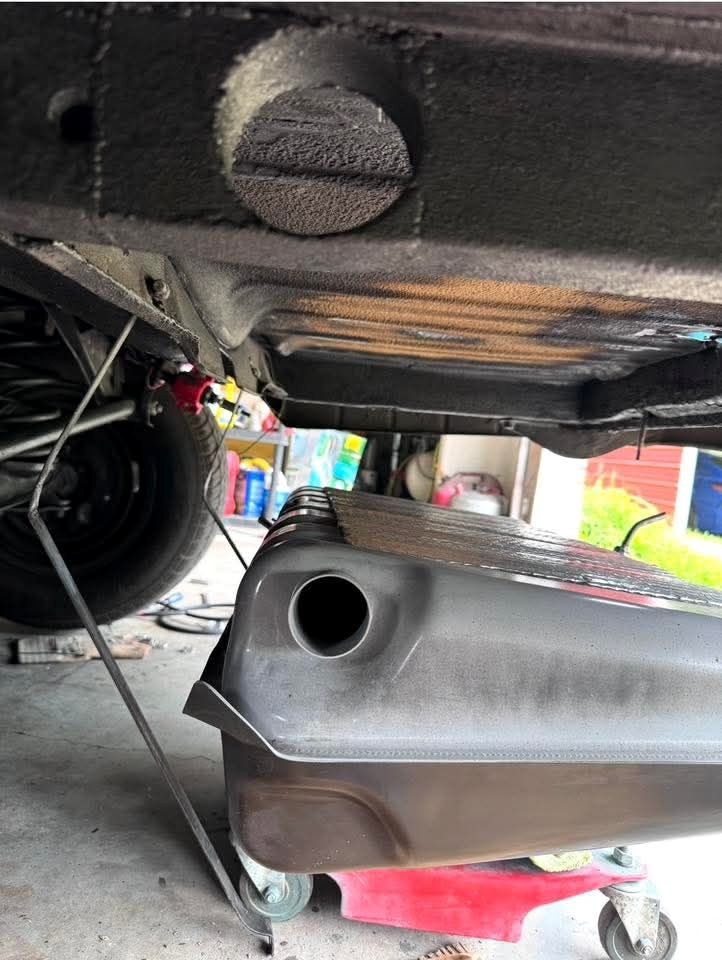
Loren McAfee’s Chevy II tank installation. Large pass through hole in sill can be seen near the top of the photo.
Other gas tanks…
While I’ve been talking about Mustang and Chevy II tanks, any gas tank can be used. Some people have mentioned Chevelle tanks, for instance. Those will work, but the sending units won’t be compatible with AMC fuel gauges. You will have to modify the sending unit or use an under dash aftermarket gauge compatible with the tank unit. This isn’t an issue with Ford tanks. Other Ford tank options from Tanks Inc. include Ford 41-48 (33-1/2″ x 19″ x 8″), 49-51 (24-1/2″ x 23-1/2″ x 7-3/4″), and 55-56 (23-1/4″ x 30-1/2″ x 7-1/2″) tanks. Most of these have left side fuel fillers. Feel free to browse their other make tanks, just remember
64-67 Chevelle tanks are wider than the Mustang and Chevy II. They have a rear filler and are 37-1/4″ x 30″ x 6-3/4″ (20 gallon). The 64-67 Chevelle station wagon tank is the same size with a left side filler.
Tanks Inc. sells various gas tanks and other items, including universal straps – anything you might need for a gas tank. Speedway Motors also carries a lot of gas tank accessories and tanks.
The dimensions of tanks on the Tanks Inc. site are the actual tank dimensions. You will see various dimensions on other sites. Sometimes they are tank dimensions, but most of the time they are the packaging dimensions. My suggestion is to use the dimensions from the Tanks Inc. site even if buying from somewhere else.