
written by Frank Swygert, 03-06-2026
Gen1 AMC V-8
(also known as Nash V-8 and/or Rambler V-8)
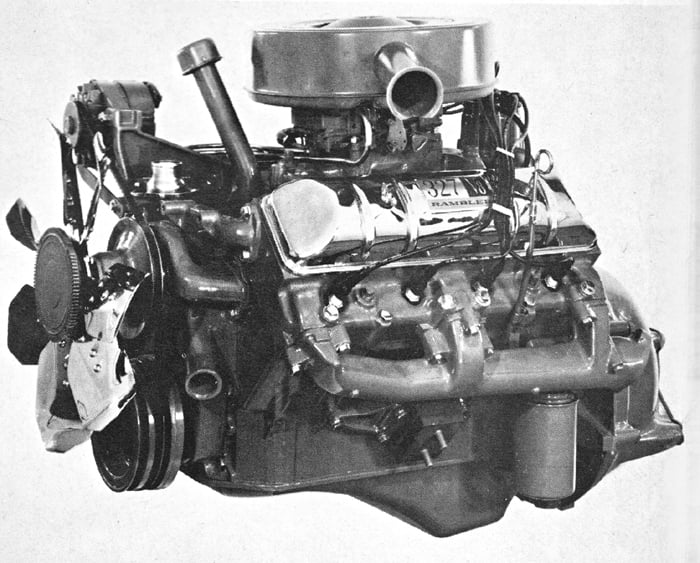
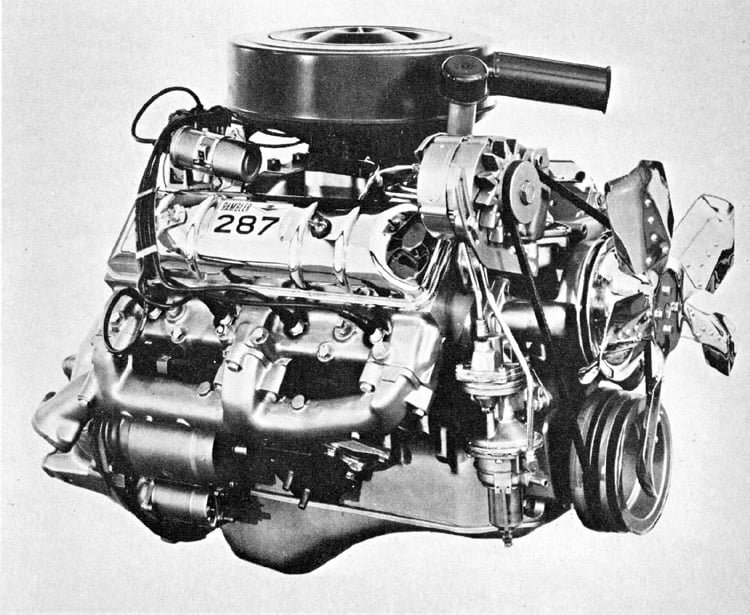
This is the first AMC V-8, hence the “AMC Gen1” (AMC Generation 1). When I first popularized the usage of Gen1/Gen2/Gen3 monikers for the AMC V-8s in “American Independent Magazine” back in 1998 a few people were upset since GM used Gen I, II, etc. (usually with Roman numerals) for their V-8s originating with the small block Chevrolet (SBC) V-8. Well, the GM names had nothing to do with me using the “Gen#” naming convention, just a realistic name that made sense. Calling this the Nash or Rambler V-8 can be confusing, though Nash they were first used in the 1956 Nash Ambassador and Hudson Hornet Specials (Stateman and Ambassador bodies with Ambo and Hornet trim, two door only). AMC was formed in 1954 by the merger of Nash and Hudson, the engine wasn’t on the drawing board until 1955.
Greg Taylor used to have a great web page dedicated to the AMC Gen1 V8. Alas, it’s lost! There was a site with a copy of most of it on the web even after Greg’s site went down, but I couldn’t find it. Some of the content below is mine, some is copied from https://en.wikipedia.org/wiki/AMC_V8_engine (I have done some editing on that article). Another site with lots of AMC Gen1 V8 info is https://www.jubileejeeps.org/327/index.htm. I will copy a lot of that info to this site, all public domain stuff.
AMC didn’t start out to make their own V-8s
Here’s where the origin story gets interesting! AMC didn’t intend to make their own V-8s at first. George W. Mason, CEO of first Nash-Kelvinator then AMC, had a grand vision of all the surviving independent auto makers merging to form a large enough company to compete with the U.S. “Big Three” (not that I need to name them, but General Motors, Ford Motor Company, and Chrysler Corporation). By 1954, the year Nash merged with Hudson (Nash actually bought Hudson out), there weren’t many independents left. Studebaker and Packard merged that same year (Packard actually bought out Studebaker). Kaiser-Willys was still producing cars and Jeeps, but they would end car production (in the US) in 1955. Kaiser-Jeep would continue until bought out by AMC in 1970. That was it – no other passenger car manufacturers in the U.S. except for a handful of really small ones that were insignificant to the overall market – like the King Midget. Only around 5000 King Midgets were sold from 1946 to 1969.
Mason knew that mergers and shared components were the only way the remaining independent corporations would survive in the long run. He had meetings with James J. Nance, Studebaker-Packard CEO, and a merger between the two was framed. Once both new corporations stabilized their balance sheets and strengthened their product line, Studebaker-Packard would join AMC and become a new four marque company under the AMC name.
As most of us know, that never happened. The main reason is that George Mason died just a few months after the Nash-Kelvinator Hudson merger of acute pancreatitis and pneumonia. George Romney had been groomed by Mason to take over after Mason retired. The problem was that Romney and Nance didn’t get along very well. Nance had great respect for Mason, and had he lived things may have been different. As it was, Studebaker-Packard supplied Packard V-8s to AMC from 1954-56 along with Ultramatic transmissions, which S-P required AMC to purchase with the engines. In return S-P was supposed to buy components from AMC. Nance viewed the previous agreement with Mason as an agreement between the two men, not the corporations, and rejected all the bids AMC returned as “too high”, while charging them a premium for the V-8s they needed to compete on the early 50’s market. Well, this infuriated Romney! He directed his engineering team to come up with a V-8 design they could get into production as soon as possible.
To expedite the design work AMC hired David Potter. Potter Potter was a former powertrain engineer for Kaiser/Continental (Kaiser owned Continental Motors) and had headed the team that had played with an experimental V8 of their own design primarily created Potter himself. Kaiser determined that they did not have the sales to support building a V-8. The AMC V-8 that Potter and the AMC design team created bears a strong resemblance to the Kaiser/Continental prototype. In those slide-rule days AMC, with Potter’s help, came out with a production V-8 design in just 18 months! It was a rather heavy engine with forged crank and rods, but it turned out to be a very smooth and reliable design that was very strong. While technically it’s not a “big block”, it was closer to the size and weight of other manufacturers big block designs.
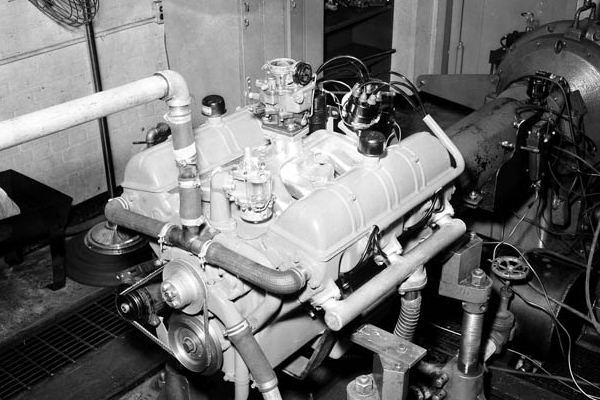
Kaiser/Continental experimental V-8 on test stand. Note some similarities with the AMC Gen1 V-8.
The first was the smallest…
The first AMC V-8 was introduced in November of 1955 with 250 cubic inches. It was only available in the Nash Ambassador Special and Hudson Hornet Special. These were Nash Statesman and Hudson Wasp two door hardtop bodies with Ambassador and Hornet trim. The engine only displaced 250 cubic inches and produced 190 hp, so the 350 pound lighter bodies helped with performance.
The 250 had a 3.50” bore and a 3.25” stroke. The block was designed with a bore center that allowed a much larger bore though. For the 1957 model year the bore was increased to 4.00” with the same 3.25” stroke forged crank as the 250. This brought displacement up to 327 cubic inches and power up to 250-270 hp, depending on compression. Another difference between the 250 and 327 was that the 250 used solid lifters with adjustable rocker arms whereas the 327 used non-adjustable hydraulic lifters.
Note that the AMC 327 was introduced five years ahead of the Chevrolet 327 small block. The only thing the AMC 327 shares with the Chevy 327 is the bore and stroke, purely by coincidence.
The block was reportedly designed for up to 400 cubic inches, but AMC never increased it beyond 327 cubic inches. Bill Kraft Rambler, a California dealer, did. His race team bored a 327 0.060” and increased the stroke by 0.75” (to 4.00”) to create a 418 cubic inch drag race engine. They installed and campaigned it in a 1964 American. AMC had repeatedly told dealers the rather big and heavy Gen1 V-8 wouldn’t fit the American body, but Bill Kraft proved them wrong. It was a tight fit, but he did it! It wouldn’t have been practical in a street car though. If you’ve ever driven a big block mid 60s Mustang you’ll know that handling is not very good! AMC didn’t want anything like that – the American (and larger engine sizes) would have to wait until they came out with the Gen2 V-8 in late 1966.
AMC also made a 287 cubic inch version starting in the middle of the 1963 model year. The 250 was dropped after 1961. Starting in 1962 the Classic and Ambassador shared the same body, just different front and rear treatments and different trim. To further differentiate the two only the Ambassador got the 327 V-8 in two-barrel 8.7:1 compression (250 hp) or four-barrel 9.7:1 compression (270 hp) versions. So if you wanted a V-8 Rambler in 62 you had to step up to the Ambassador, which had a much higher price tag. This incensed dealers – they were losing sales due to people wanting a V-8 but not the fancier (and higher priced) Ambassador. So AMC introduced the 287 V-8 in mid 1963 exclusively for the Classic, in two-barrel carb form only. As many AMC owners found out the 327 four-barrel intake fit the 287 (all parts interchange except pistons) just fine, and some made the swap later.
Although all three displacements share almost all parts, including the crank and rods, a 250 can’t be turned into a 287 or 327, nor a 287 into a 327. The three different bores use three different block castings. The bores are 0.25” different (3.50”, 3.75”, and 4.00”) – no production passenger car engine block ever made can be bored that much!
The AMC Gen1 is big and heavy, but that also makes it durable and very smooth. AMC typically under carbureted it to make it more efficient and reliable. The four-barrel carb on the 327 was only 450 cfm from the factory. This limited top end power, but unless you’re drag racing you don’t need power at 5000 rpm – you need it at 2000-3000, where most driving is done. A smaller venturi (barrel) size makes for higher charge velocity, which make more low speed power and torque. The AMC engineers knew what they were doing! If you want to run the engine harder a 600 cfm carb is a good fit, but it will still perform better in normal driving with a 450-500 cfm carb.
Performance Potential
Several people, most famously the aforementioned Kraft Rambler, have made high performance versions of the 327. Phil Heitman built a Marlin with a hopped up 327 called the “Marlin M/X” in 2011 (built 2008-2011). It was enlarged to 345 cubic inches and features dual four-barrel Edelbrock carbs on a modified Offenhauser AMC Gen2 aluminum intake with 1/2″ spacer/adapters, a modified aluminum valley pan (from a Graymarine AMC 327 marine conversion), specially modified aluminum valve covers, heavily modified and ported heads, larger valves, custom headers, a custom ground cam (an original stock hydraulic cam that was re-ground for solid lifters), solid lifters, adjustable rocker arms and shafts from a 250, custom made forged pistons, big block Chevy rods, offset ground crankshaft (for slightly longer stroke), modified deeper oil pan, and modified oil sump pickup. It produced 381 hp @ 5800 rpm and 392 ft-lbs of torque @ 4400 rpm on an engine dyno. Respectable for an engine of that size.
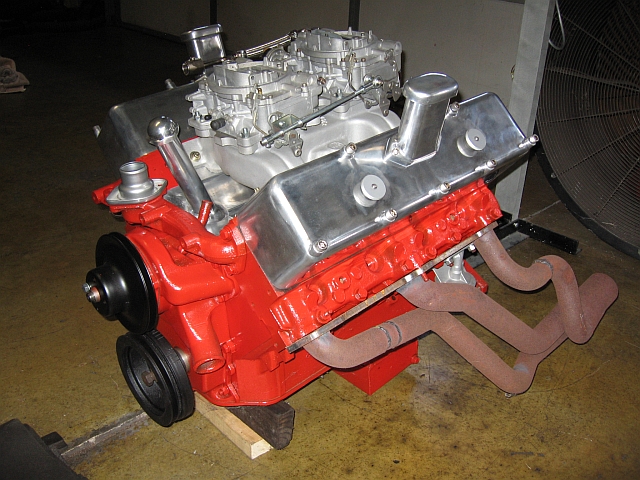
Phil Heitman’s “Marlin M/X” 345 AMC Gen1 V-8
There are no speed parts readily available. Erson and Iskendearian had cams listed in the 60s and early 70s, but those are long gone. Any cam company can re-grind a stock cam for improved performance as Phil had done (I had Lunati re-grind a 195.6 six cam in the 90s). There are limits to how much lift and duration they can add, but they cam “pep it up”. Offenhauser is rumored to have made performance intakes in the 60s for the 327, but I’ve never seen one. Most intakes are custom made (Bill Kraft Rambler) or modified AMC Gen2 0r Gen3 intakes. All the AMC V-8s share the same bore centers, making the intake ports very close to the same location. Note that Phil Heitman mentions 1/2” spacer/adapter plates with a modified Gen2 intake. The spacers make up for the taller deck of the Gen1 and allow blending the intake ports the slight difference. The water crossover is cut off in front of the front runners on the Gen2 or Gen3 intake as well as the rear portion behind the rear runners. “Headers by Ed” (www.headersbyed.com) has header flanges and will make custom headers or sell you a header kit with bends that you cut and weld together.
NASCAR 327
Between 1966 and 1968 Larry Hess drove a 66 Ambassador sponsored by Queen City Rambler (Charlotte, NC) in five NASCAR races. On August 18 he ran the Rambler in the Sandlapper 200 at Carolina Speedway, Columbia, SC. He only completed 170 of 400 laps (½ mile track) before breaking at least one rocker arm. On July 10th he ran the 2.85 mile road race course at Bridgehampton Raceway in New York (state), followed by the Grand National race at Fonda Speedway (also NY state). Only five laps were completed at Bridgehampton, only 1 at Fonda – both due to engine trouble (most likely rockers again). The Ambassador wasn’t raced again until 1967 at the November 5th Greenville 200 at the Greenville-Pickens Speedway in SC. It only completed five laps before engine trouble again. Hess didn’t take the Rambler out again in 67, but tried one last time in May 11, 1968 at the Rebel 500 in Darlington SC. All I could find is that 0 laps were completed – he may have entered and not qualified, had engine trouble during qualifying, or during the first lap.
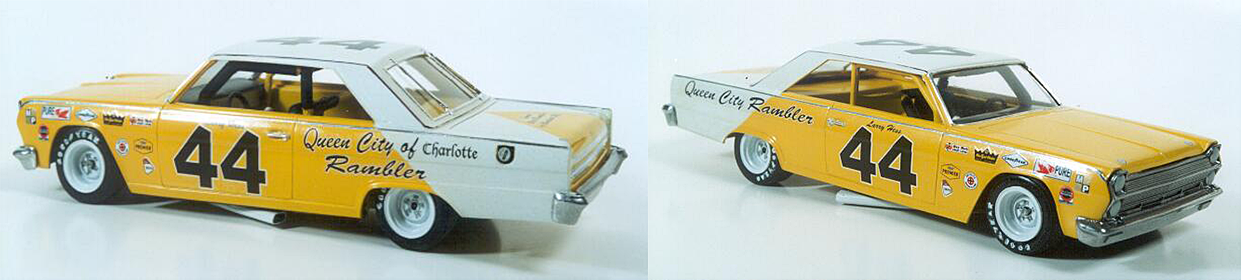
Scale model of Larry Hess’s 66 NASCAR Ambassador
Not much is known about the car. In an interview in the 80s Larry Hess mentioned that the rocker arms were a constant problem. Everyone else was running big block engines in the 421-427 cubic inch range. Hess stated that he had to run the Rambler “really hard” just to keep up, and that was a problem. The Ambassador was classified as an “intermediate” by NASCAR, not a full size model. That’s fair – others like the Ford Galaxie were larger. Intermediate cars (Fairlane, Chevelle, etc.) were limited to 405 cubic inches, not that it made a difference. Hess also mentioned running “Ford spindles”. I believe he actually meant hubs, as AMC and Ford used the same bearing sets. AMC has a bolt-on spindle, Ford uses a one-piece spindle/steering knuckle/steering arm unit. That would be difficult to make work on the AMC front suspensions that uses three separate pieces. Steering arm placement and length are likely not correct for the Ambassador also.